In this guide
Reusable freezer labels are useful when the same containers return to the freezer with different contents. The purchase only works if you can read the label while the container is stored and reliably replace the old information before the next use.
Jokari Label Once and the MESS 96-label white set are two systems to consider. The meaningful differences are the label shapes, the writing tools you need, and whether a supplied kit or a separate set of supplies fits your routine.
These are reviews of documented packages and their intended use, without a home freezer trial or a measured claim about how many rewriting cycles they survive. Treat the manufacturers' freezer and washing statements as product instructions, not independent test results from this guide.
Choose the writing system before the label count
Do not assume that every label described as erasable uses an ordinary dry-erase pen. Read the instructions for the exact set, because a label surface, a marker, and an eraser form a system that needs to work together.
Decide where those supplies will live before you order. If the pen stays in a desk and the eraser disappears into a cleaning cupboard, updating a container becomes a small scavenger hunt that you may postpone.
Choose a short information pattern that fits your own cooking routine. You might want a food name, the relevant preparation date, and a brief distinction such as a recipe version, but avoid a label so crowded that nobody wants to read it.
A label is a record, not a judgment about the food inside. It cannot establish that a container was handled correctly or determine whether its contents are suitable to eat simply because the date is easy to find.


Review: Jokari Label Once 70-label starter kit
 Check Price on Amazon
The selected Jokari package, model 47826, contains 70 assorted labels, a permanent marker, and an eraser. Jokari describes its system as rewritable and suitable for freezer, microwave, and dishwasher use on smooth plastic, glass, or stainless steel surfaces, with ovens and stovetops excluded.
The manufacturer's assortment comprises 21 labels measuring 1 by 2.5 inches, 21 measuring 0.75 by 1.75 inches, and 28 measuring 0.5 by 0.875 inches. This is a mixed-size kit, rather than 70 labels all having the largest dimensions.
Choose this package if you want the specified writing and erasing tools included at the start. That reduces the number of separate supplies you must identify, although you still need a sensible place to keep them together.
The size assortment is useful when your containers vary. A little label can identify a small tub without covering its side, while a larger one leaves more room for a name that would otherwise be shortened into an unhelpful abbreviation.
That assortment can also leave you with sizes you rarely use. Lay out your actual containers and decide how many need a readable name and date, rather than treating every label in the kit as equally valuable to you.
Check the package count on the purchase page. The manufacturer's own shop may offer multipacks, while this review concerns one 70-label kit; a photo of several packages should not substitute for the selected variant's contents.
Jokari is the clearer conditional choice when you like an included marker-and-eraser system and can use several label sizes. It is less compelling when almost every container needs a broad writing area and the tiny labels would sit unused.
Review: MESS 96-piece reusable white label set
 Check Price on Amazon
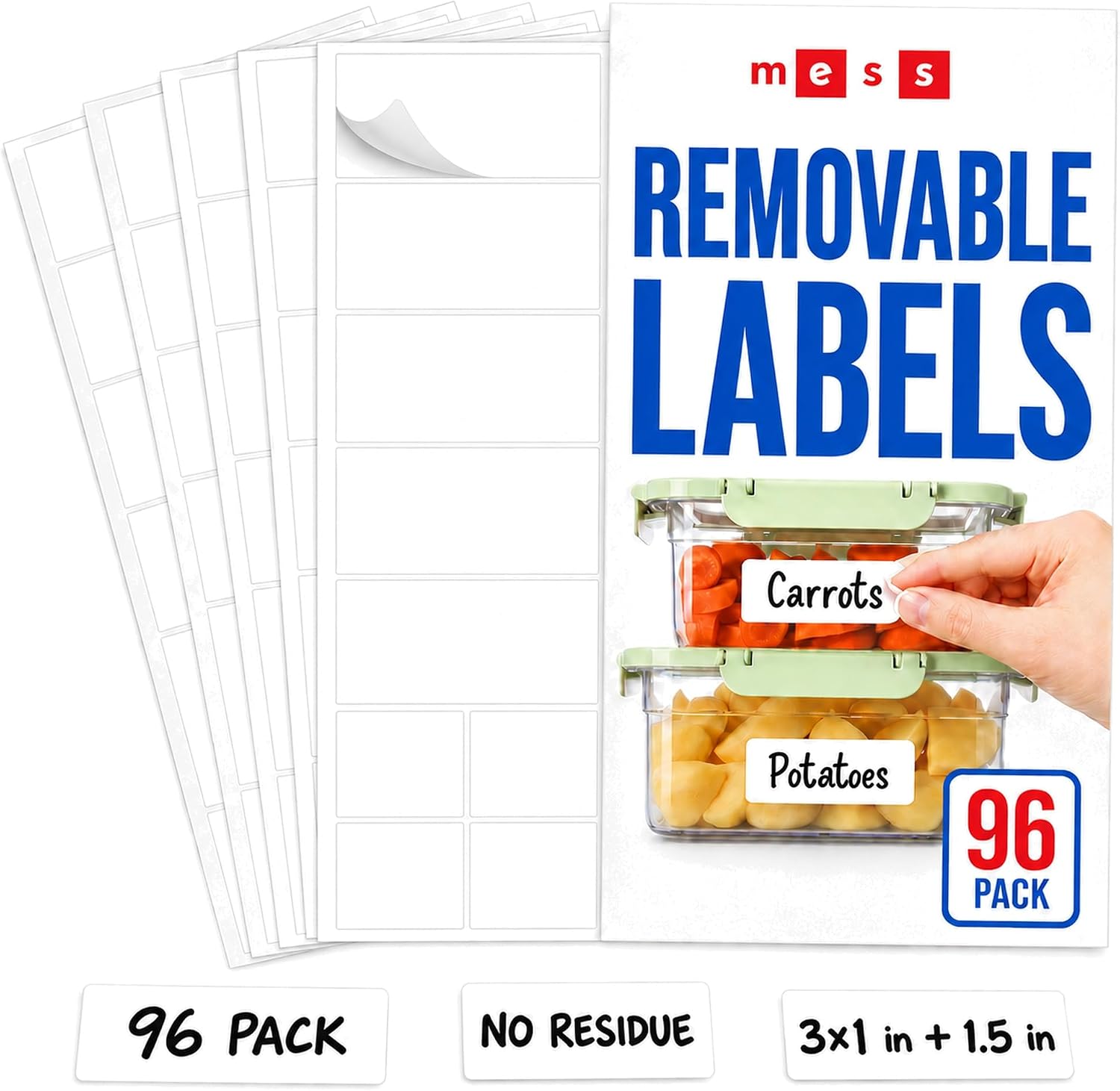
The selected MESS listing identifies a 96-label white set in 1-by-3-inch and 1.5-inch sizes. Its branded instructions describe reusable, removable labels for freezer and microwave use and top-rack dishwasher washing, with permanent-marker writing erased using an eraser; the marker and eraser are not included.
The listing title includes dry-erase wording, but the described writing routine is the permanent-marker-and-eraser method above. Check the supplied instructions before choosing a pen, and do not buy on the assumption that the title specifies a conventional whiteboard marker.
Consider this set if the writing areas suit your containers and you already have, or will deliberately obtain, the specified supplies. A larger label count does not remove the need to confirm how you will write and erase each one.
Use a paper outline to picture the longer label on a short tub. A label that wraps around a corner or disappears behind the neighboring container may give you less readable space than its dimensions suggest.
The different shapes give you another layout choice. You could reserve the longer area for a descriptive name and a date, while using a compact shape where a short identification is enough, provided the result stays readable in its stored position.
Removability and rewriting solve different problems. You may want to leave a label on one container and change its writing, or remove it as your storage arrangement changes; decide which action you actually expect to repeat.
MESS is the conditional choice when its format and separate-supplies approach fit your routine. Pass if you want an unambiguous starter kit with all writing tools included, or if the selected label shapes do not fit the surfaces you can see.
Place the label where you will look
Stand in front of your freezer and look at a typical row of containers. A beautifully written lid label offers little help when the lids are hidden beneath the shelf above and only the front edges are visible.
For a stack, think about which parts remain exposed after another container is added. Make the information readable without lifting a pile or turning several tubs, and keep the label clear of a grip or closure you need to use.
Check the container's shape as well as its available area. A deeply textured, strongly curved, or obstructed surface deserves closer attention to the label's instructions before you assume it provides a suitable place to attach one.

On a small screen, scroll the diagram sideways to read its labels.
Use a brief, consistent name that another person in the household can understand. A private abbreviation saves writing space until someone mistakes one sauce for another and has to interrupt you to identify it.
Make rewriting part of refilling
Choose a definite moment to clear the old information. Updating an empty container before filling it again is easier to remember than hoping you will return to the freezer later with a marker.
Read the finished label once while you can still see the food you are identifying. Catching a missing date or a copied name at that point takes less effort than reconstructing the contents from memory on another day.
Keep unrelated notes off the same small writing area. A freezer label works better as a short record than as a compressed recipe, a shopping reminder, and a reheating plan competing for the same few inches.
If other people use the system, show them where the supplies live and what information belongs on the label. Consistency is a household agreement rather than a feature that arrives in the package.
Before labeling every container, write out your longest ordinary food name on paper at the intended size. If you must shrink the lettering until it is difficult to read, simplify the information or reconsider the label format.
When neither set solves the problem
Neither set is an obvious purchase for disposable wrapping, irregular surfaces, or containers without an appropriate attachment area. You may need a different identification method designed for that packaging instead of forcing a reusable adhesive label into the wrong job.
Skip both if your real obstacle is an overcrowded freezer where no label is visible. Rearranging the storage or reducing competing stacks can be more useful than adding another layer of writing to containers you still cannot see.
Choose Jokari for its included tools and mixed sizes. Choose MESS when its specific shapes suit your containers and you are prepared to supply the stated writing tools; in either case, build the habit of replacing old information before relying on the label again.