In this guide
- Measure the usable drawer, including the opening
- Review: Joseph Joseph DrawerStore expanding organizer, 8500015
- Review: ROYAL CRAFT WOOD expandable tray with removable knife block
- Plan the loaded layout before filling every compartment
- Expansion is a fit adjustment, not extra storage by itself
- When neither organizer is the right choice
- Sources & further reading
An expanding drawer organizer can combine utensils and knives in one place, but it only helps if the loaded arrangement fits. The width of the empty tray is just the beginning; knife handles, the drawer opening, and the space above the contents can decide whether the setup is practical.
The Joseph Joseph DrawerStore expanding organizer with a knife section and ROYAL CRAFT WOOD's expandable tray with a removable knife block are two specific options. Both deserve consideration for a combined drawer, rather than for someone seeking a narrow knife-only insert.
These reviews compare verified product configurations and documented dimensions. They do not claim a hands-on fit test, universal compatibility with knives, or a child-resistant storage system.
Measure the usable drawer, including the opening
Empty the drawer and measure its interior width and depth. Check for screw heads, a curved back, or other intrusions that make the usable rectangle smaller than the broadest measurement suggests.
Then examine the route the loaded organizer must pass through when you open and close the drawer. A handle can clear the drawer sides yet catch on the cabinet frame above, so internal wall height alone is not enough.
Write down the knife shapes and utensils you want to keep there. A collection of broad handles asks for a different arrangement from a few slim tools, even when the number of knives is identical.
Keep your regular work sequence in mind. If you only need a knife drawer and already have a convenient utensil drawer, a combined expanding tray may occupy space without solving a real problem.

Review: Joseph Joseph DrawerStore expanding organizer, 8500015
 Check Price on Amazon
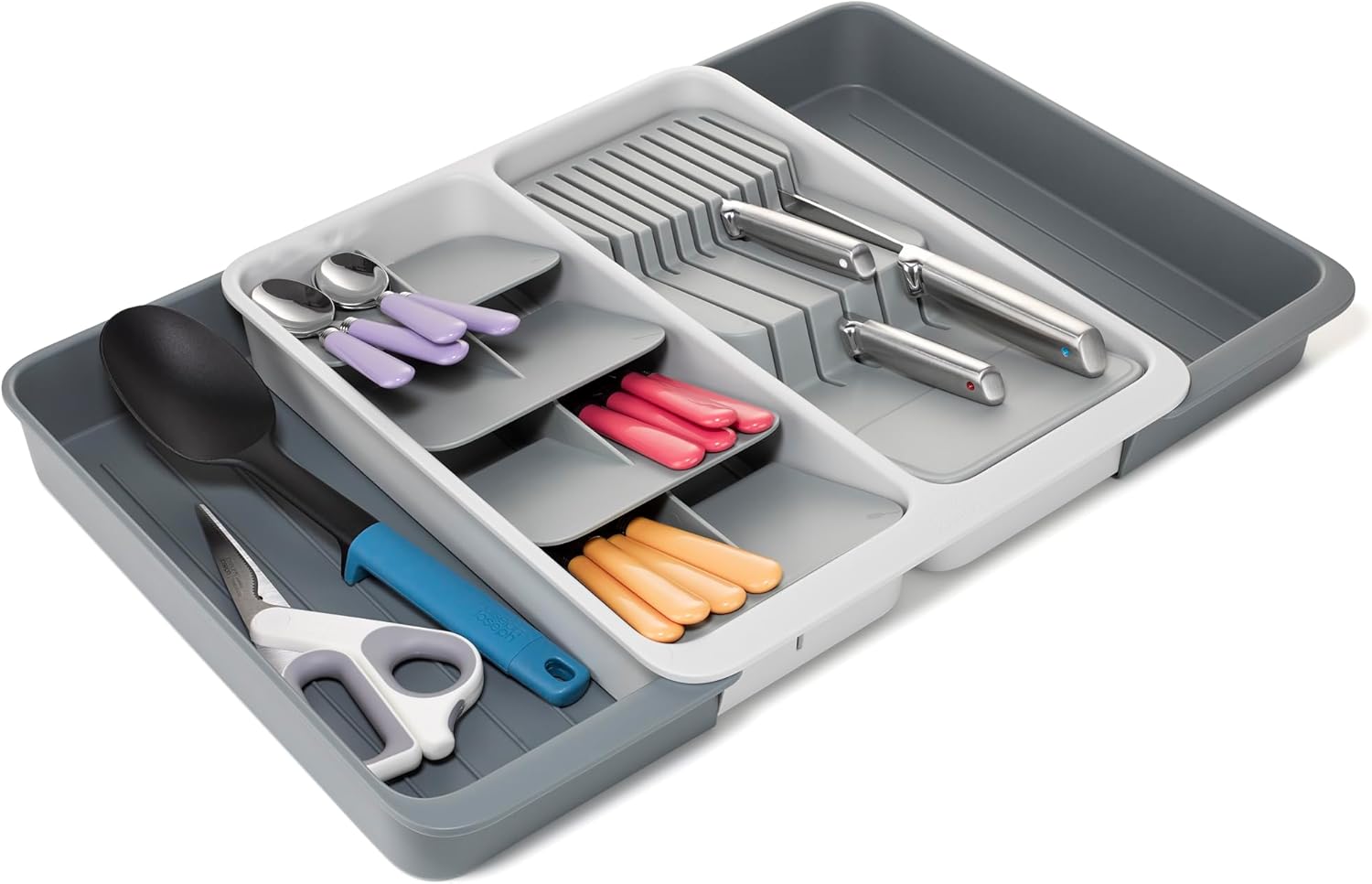
Joseph Joseph identifies model 8500015 as an expanding organizer with side trays and a two-tier knife section. Its official dimensions are 6.15 cm high, 33.7 cm wide, and 39.9 cm deep; the maker calls for a drawer at least 9 cm high and specifies handwashing and drying.
The official page calls the color Stone, while the matching Amazon selection calls it Grey. Use the model number and combined utensil-and-knife configuration to check the purchase, rather than assuming every DrawerStore insert is the same product.
Choose this design if you want a combined layout with a dedicated knife area and room to arrange everyday utensils alongside it. Think about whether those items belong together in your cooking routine before giving the tray an entire drawer.
The two-tier arrangement makes handle clearance particularly worth checking. Map where your own handles will sit and confirm that you can identify and retrieve each intended knife without an awkward reach across another part of the arrangement.
Do not use the organizer's own height as your only clearance figure. The manufacturer gives a larger minimum drawer height, and your loaded setup still needs enough usable space beneath the cabinet opening.
The verified evidence does not establish a maximum expanded width for this exact model. If your purchase depends on reaching a particular wide drawer, obtain that exact dimension from the maker or the current product documentation before committing.
Consider the cleanup routine as well. A combined tray can gather the small debris that follows utensils into a drawer, so plan to remove its contents and follow its care instructions rather than wiping only the visible knife handles.
Joseph Joseph is the conditional choice when its documented depth and height fit, you want its combined layout, and the expansion range is confirmed for your drawer. Pass if your plan relies on an unverified maximum width or uncertain knife-handle clearance.
Review: ROYAL CRAFT WOOD expandable tray with removable knife block
 Check Price on Amazon
The selected Natural eight-compartment tray listing specifies a 17-inch depth, 13-inch starting width, and 1.9-inch tray height, expanding to 19.6 inches wide. This exact package includes a removable seven-slot knife block and describes damp-wipe care.
The eight-compartment description refers to the tray arrangement, not to eight knife slots. Check the removable seven-slot block in the selected package, because a similar-looking standard utensil tray from the same brand does not establish that the block is included.
This configuration is worth considering if you want the option to rearrange a combined utensil drawer around a removable knife section. Decide where that section would go in your real drawer before treating removability as a benefit on its own.
Its stated width range gives you numbers to compare with the clear space you measured. You still need to account for drawer shape, neighboring items, and any obstruction along the path of the expanding sides.
The tray's 1.9-inch height is not a promise that your loaded knife handles will clear a drawer opening of that height. Consider the whole arrangement, including whatever projects above the block, and leave the drawer usable without pushing it shut against resistance.
Seven slots do not guarantee a suitable position for any seven knives. Compare handle spacing and blade geometry against the exact block's instructions, particularly if your collection includes broad blades or unusually substantial handles.
The brand's standard organizer page supports the general tray family, but it does not document this newer knife-block package in full. The exact Amazon listing is the purchase reference here, so keep the package and dimensions tied to that selection.
Choose this ROYAL CRAFT WOOD conditionally when the published width range and depth fit your drawer and the removable block suits your knives. Pass if you need guaranteed compatibility that the current exact-model information does not provide.
Plan the loaded layout before filling every compartment
Use paper rectangles to compare the documented footprints with the empty drawer. Mark the knife section and the utensil groups, then leave enough practical room to reach the things you use most often.
Do not place loose sharp knives in a paper mockup to demonstrate the fit. Use dimensions and outlines for planning, then follow the real organizer and knife instructions when you establish the finished arrangement.
Think about the drawer at an ordinary halfway-open position. You should be able to see what you intend to retrieve, rather than needing to pull the entire drawer out while your other hand is busy with food preparation.

On a small screen, scroll the diagram sideways to read its labels.
Expansion is a fit adjustment, not extra storage by itself
Opening side trays changes the space available for utensils, but it does not increase the drawer's depth or its overhead clearance. Decide which constraint you are trying to solve before focusing on the advertised width range.
A tray that nearly fills the drawer may leave an awkward strip beside it. Plan a useful role for that strip or leave it clear, rather than turning it into a place where miscellaneous objects can drift against the knife section.
Review the utensil count before assigning every compartment. Keeping tools you rarely use somewhere else can give your everyday items more room and make a combined organizer easier to navigate.
If several people share the kitchen, agree where each item belongs. A clear layout only stays useful when a knife returns to its designated place instead of being dropped among measuring spoons because an adjacent slot was occupied.
Check whether the drawer is convenient from your actual preparation position. An organizer may fit perfectly yet leave you repeatedly walking around an open dishwasher or another person, in which case a different drawer assignment deserves consideration.
When neither organizer is the right choice
Neither option is an obvious fit for a very shallow drawer, an unusually short drawer, or a knife collection outside the documented configuration. Seek an appropriately sized alternative instead of forcing an expanding tray past a cabinet obstruction.
Skip both when you need a storage arrangement that controls children's access. An in-drawer organizer alone does not establish that protection, and this comparison has no evidence supporting such a claim for either product.
Choose Joseph Joseph when the combined tiered layout and documented minimum clearance work, with expansion confirmed. Choose ROYAL CRAFT WOOD when its exact width range, deeper footprint, and removable seven-slot block suit your measured drawer and actual knives.